What Is a Funnel? When It Helps and When It Doesn’t
A funnel is not just a diagram marketers draw to look busy. It is a practical way to think about how strangers become leads, leads become opportunities, and opportunities become customers.
So, what is a funnel? Here is the simple sales funnel explained: it is a planned journey that moves people through stages of awareness, interest, decision, and action. It is useful when the buyer needs more than one touch before converting, when follow-up matters, or when you need to understand where prospects drop off.
This guide explains when a funnel is useful, when it is overkill, and how Kalingo can help you build a simple version that works in the real world.
What a funnel actually means
A funnel is a sequence of steps designed around the customer’s decision process. At the top, people become aware of a problem or offer. In the middle, they compare, learn, ask questions, and evaluate fit. At the bottom, they take action: book, buy, request a quote, start a trial, or speak with your team.
The word “funnel” can sound mechanical, but the best funnels are human. They help people get the right information at the right time and make the next step feel clear.
When a funnel is useful
- The decision takes time: If your buyer needs education, comparison, or approval, a funnel helps you guide the journey instead of hoping they remember you later.
- The offer is valuable or complex: Services, consultations, B2B offers, courses, clinics, agencies, and high-consideration products often need more than one page.
- Follow-up affects conversion: If leads often go cold because nobody responds quickly, the funnel should include reminders, confirmations, and clear ownership.
- You have multiple traffic sources: Funnels help you match each source to the right message, landing page, and next step.
- You need better measurement: If you know traffic is coming in but do not know where it disappears, funnel tracking can show which stage needs attention.
When a funnel might be overkill
Not every business problem needs a complex funnel. Sometimes you need a clear page, a good offer, and faster follow-up. A funnel becomes too heavy when it adds steps the buyer does not need.
For example, a simple restaurant reservation page probably does not need a 14-email educational sequence. A quick quote request for a local service may need a focused landing page, a short form, and rapid response. Complexity should serve the buyer, not impress the marketer.
The four basic funnel stages
- Awareness: The visitor discovers the problem, opportunity, or offer through search, ads, referrals, social, or email.
- Interest: They read, watch, compare, download, register, or browse. Your job is to answer the next logical question.
- Decision: They evaluate trust, pricing, timing, fit, proof, and risk. Clear FAQs and follow-up matter here.
- Action: They book, buy, reply, call, request a quote, start a trial, or complete another meaningful step.
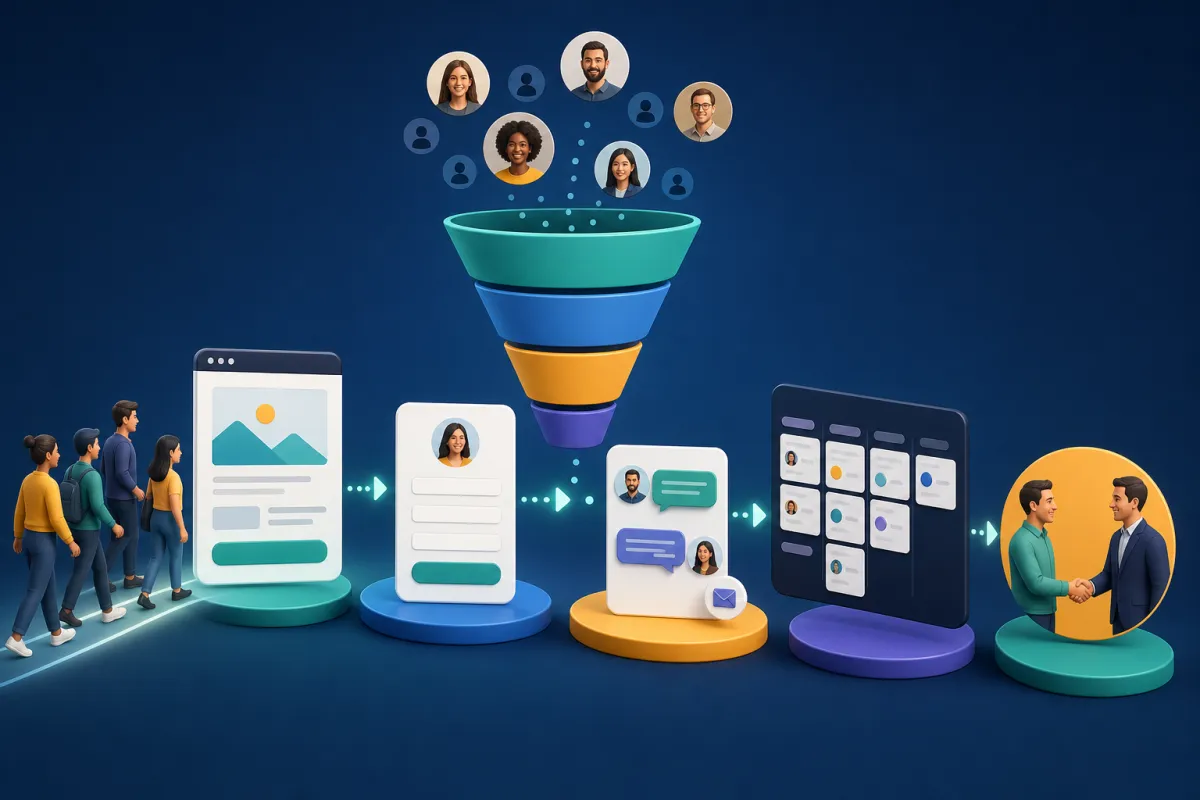
For a quick mental diagram, picture four connected blocks: discover, consider, decide, act. Each block needs one useful message and one clear next step. If a block has no next step, that is usually where the funnel starts leaking.
Examples of useful funnels
Lead magnet funnel: A visitor downloads a checklist, then receives helpful follow-up that leads to a demo or consultation.
Appointment funnel: A visitor lands on a service page, books a time, receives confirmation and reminders, then gets follow-up after the appointment.
Quote funnel: A prospect completes a short form, enters the CRM, receives confirmation, and your team follows a clear pipeline process.
Product education funnel: A visitor reads product education, views proof, receives relevant follow-up, and returns to buy when ready.
Home services funnel: A homeowner searches for urgent help, lands on a focused service page, requests a quote, and receives fast confirmation with the next step.
Clinic funnel: A patient reads about a treatment, checks the FAQ, books a consultation, and receives reminders so the appointment does not disappear into calendar fog.
Coaching funnel: A visitor downloads a worksheet, receives helpful follow-up, watches a short case example, and books a fit call when ready.
A simple funnel workflow you can copy
- Focused page: Send visitors to a page that matches their intent and explains one offer.
- Lead capture: Use a form, booking step, or purchase action that matches the next commitment.
- Confirmation: Tell the person what happens next so they are not left guessing.
- Follow-up: Send helpful reminders, resources, or next-step messages based on the action they took.
- Pipeline ownership: Assign the next internal action so no lead is lost between marketing and sales.
- Review: Look at high-level metrics such as page views, opt-ins, orders when relevant, and pipeline movement to find the weak stage.
How Kalingo helps you build a practical funnel
Kalingo helps small businesses connect the moving parts: landing pages, forms, CRM records, follow-up automations, booking, pipeline tracking, and reporting. That connection is what turns a “funnel idea” into a working business process.
- Capture: Use focused pages and forms to collect the right lead information.
- Organize: Keep new contacts and opportunities visible in the CRM and pipeline.
- Follow up: Send confirmations, nurture messages, reminders, and team notifications.
- Measure: Review funnel activity and outcomes so you can improve the weak stage.
Common mistakes to avoid
- Confusing a funnel with a single page: A page can be part of a funnel, but follow-up and measurement usually matter too.
- Adding too many steps: More steps do not automatically mean more sales. Use the fewest steps that help the buyer move forward.
- Ignoring intent: A cold visitor and a referral lead usually need different messages.
- Forgetting the handoff: If a lead converts but nobody owns the next action, the funnel leaks.
Summary and next steps
A funnel is useful when the customer journey has stages, follow-up matters, and measurement can improve results. Keep it simple, helpful, and aligned with the buyer’s intent.
Next step: Try Kalingo to build a simple funnel that captures leads, organizes follow-up, and shows where opportunities move next.
Recommended next reads
- Marketing Automation for Small Businesses: What to Set Up First
- Automated Lead Follow-Up: 7 Workflows That Turn More Enquiries Into Customers
- Lead Scoring for Small Businesses: When to Call, Email, or Wait
Ready to compare options? View Kalingo pricing plans and choose the setup that fits your next growth move.
Frequently asked questions
What is a funnel in marketing?
A marketing funnel is a planned journey that helps a visitor move from awareness to interest, decision, and action. It usually includes pages, offers, lead capture, follow-up, and measurement.
When should I use a funnel?
Use a funnel when the decision takes more than one touch, when leads need follow-up, or when you need to understand where people drop off before buying or booking.
Can a landing page be a funnel?
A landing page can be the entry point of a funnel, but the full funnel often includes follow-up, CRM tracking, reminders, sales activity, and reporting.
How does Kalingo fit into a funnel?
Kalingo helps connect the funnel pieces: landing pages, forms, CRM, automated follow-up, pipeline tracking, and reporting.